
Getting to Arashiyama
Arashiyama is located in the western part of Kyoto - getting there is very easy via several routes.
🚃 Hankyu train: from Kyoto-Kawaramachi or Umeda (Osaka) station to Arashiyama station (Hankyu Arashiyama line)
🚃 JR Sagano train: from Kyoto or Osaka station to Saga-Arashiyama station (JR Sagano/San-in line)
🚃 Randen tram: from Shijo-Omiya station to Arashiyama station (Keifuku Randen line)
⏳ Travel time from Kyoto: ~20-30 min
⏳ Travel time from Osaka: ~50-60 min
 Tip: The most convenient station for most sights is Saga-Arashiyama (JR). From there it’s just a few minutes’ walk to the bamboo forest.
Arashiyama is easiest to combine with sightseeing in the city itself - our Kyoto first-trip guide covers the must-sees.
Places to visit in Arashiyama
1. Arashiyama Bamboo Forest
The Arashiyama Bamboo Forest is perhaps one of the most iconic sights in Japan. Towering green bamboo stalks rise on both sides of a narrow path, creating a fantastic tunnel. When the wind blows, the forest hums - and that sound has officially been recognised as one of the “100 Sounds of Japan Worth Hearing”.
⏳ Opening hours: open 24/7
💶 Entry: free
📍 Location: near Saga-Arashiyama station (JR) or Arashiyama station (Hankyu)
Please note: Come as early as possible - by 8-9 am it’s relatively calm, but after 10:00 the forest fills with tourists. The best light for photos is in the morning, when rays filter through the stalks.

After the forest, it’s worth strolling along the Oi River embankment - especially beautiful in autumn when the maples turn vivid red and gold.


2. Iwatayama Monkey Park
Iwatayama Monkey Park is a small park on the summit of Arashiyama mountain, where over 120 Japanese macaques live in the wild. The climb takes about 20 minutes along a forest trail, but the view from the top over Kyoto and the Oi River is a complete reward.

⏳ Opening hours: 9:00-16:00
💶 Entry: paid (~800¥)
🥜 Feeding: inside the hut you can buy nuts and apple slices and feed the monkeys through the wire mesh
 Official Iwatayama Monkey Park website.
Please note: The monkeys roam freely all over the mountain, so you may encounter them right on the trail during the climb. Do not try to touch or feed the monkeys outside the hut - this is prohibited by park rules.
Official Iwatayama Monkey Park website.
Please note: The monkeys roam freely all over the mountain, so you may encounter them right on the trail during the climb. Do not try to touch or feed the monkeys outside the hut - this is prohibited by park rules.

3. Adashino Nenbutsu-ji Temple
Adashino Nenbutsu-ji is one of the most poetic and tranquil temples in Japan. Its grounds hold over 8,000 stone statues and grave markers of people whose bodies were once abandoned without burial in the Saga mountains. In the 9th century, the monk Kukai (Kobo Daishi) gathered all these remains and conducted memorial prayers - and so this temple came to be.

⏳ Opening hours: 9:00-17:00 (December-February until 16:30)
💶 Entry: paid (~500¥)
📍 Location: Saga-Toriimoto district, in the north of Arashiyama, ~20 min walk from the bamboo forest
Official Adashino Nenbutsu-ji Temple website.
Please note: The temple is located in the quiet Saga-Toriimoto district - the walk there through an old street lined with traditional houses is itself part of the experience. Twice a year - in late August and in September - a “Toba” ceremony is held here, where the statues are illuminated with candles.
 Secret: The temple grounds have their own mini bamboo forest - far less known and significantly less crowded than Arashiyama’s main tourist attraction. If you want to experience the atmosphere of bamboo groves without the crowds - this is the place.
4. Hōkyō-in Temple
Hōkyō-in is a small Rinzai Zen Buddhist temple located between the bamboo forest and the Oi River. What draws visitors here is not the architecture but the garden - quiet, refined, Japanese in every detail. A moss garden with a stone lantern and a small pond gives a sense of complete calm even at the height of tourist season.
⏳ Opening hours: 9:00-16:00
💶 Entry: paid (~500¥)
📷 Restrictions: tripods and selfie sticks are not allowed

 Please note: Hōkyō-in is often skipped by tourists - and that’s a shame. This is exactly why it’s worth visiting: it’s quiet here. Especially beautiful in spring during the blossoms and in autumn when the maple leaves turn red.Official Hōkyō-in Temple website.
5. Otagi Nenbutsu-ji Temple
Otagi Nenbutsu-ji is one of Japan’s most unusual and “smiling” temples. Its grounds are home to 1,200 unique stone figures of rakan (disciples of Buddha), each carved by ordinary people under the guidance of sculptor Kocho Nishimura in the 1980s. Each figure has its own facial expression - some look funny, others pensive, others childlike. The atmosphere here is not at all sombre, but joyful and warm.

⏳ Opening hours: 9:00-16:00
💶 Entry: paid (~500¥)
📍 Location: near Adashino Nenbutsu-ji, Saga-Toriimoto district
Please note: The temple sits at the very end of the Saga-Toriimoto street and is usually much less crowded than the centre of Arashiyama. After visiting Adashino Nenbutsu-ji it’s literally a few minutes’ walk - both temples are easy to combine in a single stroll.
 Official Otagi Nenbutsu-ji Temple website.
Cafes and restaurants
Pancakes - a cosy spot with Japanese pancakes, perfect for a snack during your walk.
Brunch cafe - a great place for a leisurely breakfast or brunch surrounded by the greenery of Arashiyama.

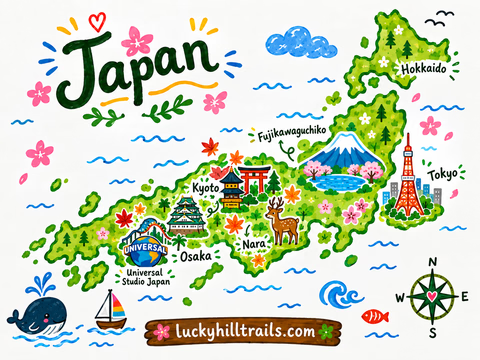
Every spot in this guide is pinned in our Japan Google Map, alongside 130+ other locations across Tokyo, Osaka, Kyoto, Nara, and Fujikawaguchiko.
Don't just read about it – go!
By booking through my links, you support my work at no extra cost to you. Thank you for helping me keep sharing travel tips 💚